Vedic Literature · Part II
VedakathaStories from the Vedic Literature
Discover the wisdom of Vedic thought through stories
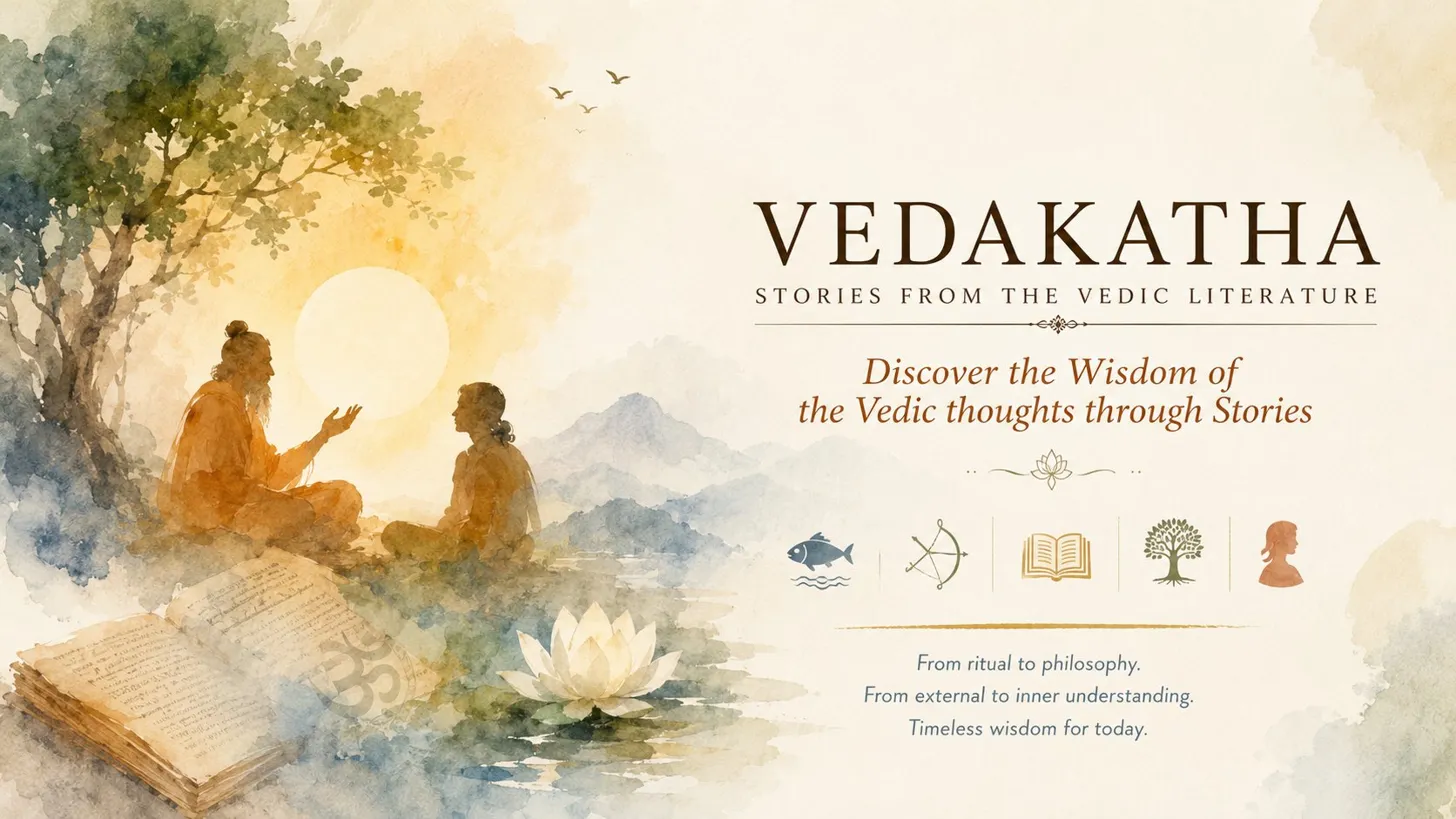
About This Course
Five stories. Two layers of Vedic literature.
Most people encounter the Vedas as hymns, as chants, as ritual. What few realise is that within this vast body of literature, there are also stories. Not parables written to teach a lesson, but full narratives, told across generations, carrying within them the philosophical questions of their time.
This course curates five such stories from two layers of Vedic literature: the Brahmana texts and the Upanishads.
The Brahmana Granthas are prose works attached to the Vedas. They deal with ritual, but they also preserve some of the oldest stories in Indian literature. This course begins with two of them. The first is the Manu-Matsya Katha, a flood narrative in which a fish warns a man of the coming deluge. The second is the Shunahshepa Katha, a story of a boy marked for sacrifice, and the impossible questions that follow.
The Upanishads represent the pinnacle of the Vedic thought. The Vedanta represents the zenith of the Vedic thought, the Anta (literal meaning: end) in Vedanta represents culmination. Here, the Vedic enquiry turns inwards, and produces timeless insights into the human existence. Through Upanishadic stories deepest questions are posed: What is the self? What survives death? What does it mean to truly know something?
Dr. Sucheta Paranjpe draws from the Chandogya Upanishad and the Brihadaranyaka Upanishad, two of the oldest and richest Upanishadic texts. A final lecture recovers something long underweighted in the received tradition: the women who participated in these conversations, not as bystanders, but as thinkers.
No background in Sanskrit or Vedic studies is needed. The course is designed for anyone willing to listen closely.
Structure
Curriculum
5 lectures · 5 texts · 4.5 hours
Faculty
Course Instructor
.jpg)
Dr. Sucheta Paranjpe
Course InstructorA gold medallist in science who chose Sanskrit. Dr. Paranjpe studied at Fergusson College, Pune, and holds a Ph.D. in Vedic Studies with a UGC fellowship. She has taught Sanskrit and Indology at Savitribai Phule Pune University and Tilak Maharashtra Vidyapeeth, and has contributed to the Cultural Index Project and the Infosys Academic Program at the Bhandarkar Oriental Research Institute. Through lectures, writing, webinars, and social media, she has brought the Vedas to audiences who might never have encountered them in an academic setting.
Common Questions
Do I need to complete Vedakatha Part I?
No. Part I covered the Rigveda. This course covers the Brahmana texts and the Upanishads. Each part stands on its own.
Is this suitable for someone with no background in Vedic literature?
Yes. Each text and its context are introduced before entering the narrative. No prior knowledge is needed.
What is the language of instruction?
English. Sanskrit terms and passages appear in context with translation.
How long do I have access?
Lifetime. Self-paced, no expiry.
Will I receive a certificate?
Yes, upon completing all five lectures.
How is this different from reading the Upanishads on my own?
A translation gives you the words. This course gives you the reading: historical context, narrative structure, and the philosophical stakes a text alone does not make visible.
From ritual to philosophy. Five stories through the tradition.
Self-paced · Lifetime access · Certificate of completion